

Care of the tree Acacia tetragonophylla or Kurara |
|
The Acacia genus, of the Fabaceae family, includes some 1,200 species of shrubs and trees native to Australia, Africa, Asia and South America. Some species are: Acacia tetragonophylla, Acacia saligna, Acacia paradoxa, Acacia melanoxylon, Acacia luederitzii, Acacia longifolia, Acacia karoo, Acacia iteaphylla, Acacia greggii, Acacia dodonaeifolia, Acacia dealbata, Acacia cultriformis, Acacia hebeclada, Acacia tortilis, Acacia truncata, Acacia pendula. Common names: Curara, Dead finish o Kurara. This species is native to western Australia. It is a short-stemmed shrub or small tree that tends to branch from the base and reach 5 meters (16.40 feet) in height. The leaves are rigid, linear and have a thorny tip. The yellow flowers appear in globose inflorescences. It blooms in winter and spring. From the pod-shaped fruits you can get seeds for reproduction. Curara is often used to fix dry slopes or to form windbreaks and informal hedges. It is ideal for Mediterranean coastal gardens. Acacia tetragonophylla needs full sun exposure and a dry and warm climate. It has good frost resistance. Dead finish can grow in any type of well-drained soil, whether sandy, calcareous, stony, clayey or poor. Kurara plants are highly drought-resistant, so water moderately during spring and summer. Always wait until the soil has completely dried out before watering again. Fertilizer is not required. Kurara can be pruned a little after flowering to control its growth. Acacia tetragonophylla is plant resistant to the usual pests but sensitive to excess watering. Propagation is simple from seeds sown in spring. It is advisable to immerse them a few seconds in boiling water and leave them to soak overnight in warm water. |
Images of the tree Acacia tetragonophylla or Kurara |
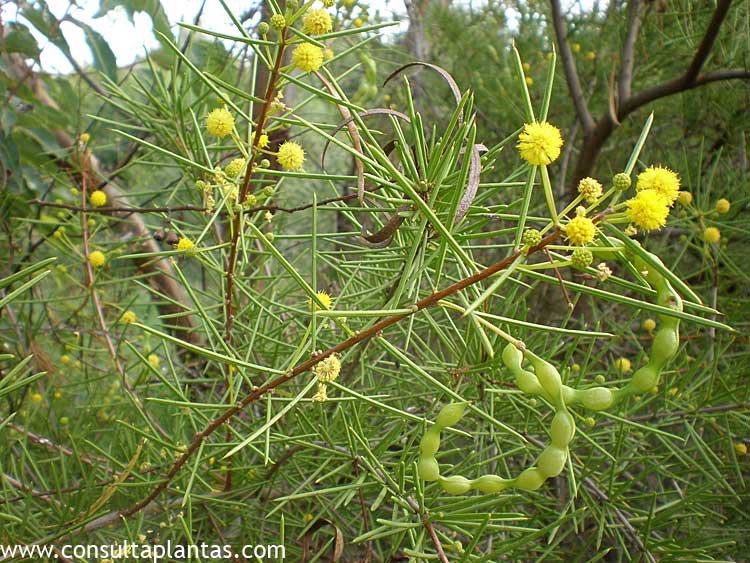 Acacia tetragonophylla  Acacia tetragonophylla |